When SRS Stops Teaching the Card
Development Journal
Traditional spaced repetition is very good at answering two questions: what should appear next, and when should it appear? But a card can become too good at teaching itself. If the same prompt and answer keep returning, it is possible to remember the card without fully learning the lexical unit behind it.
That is the problem behind Vocabilis’ current Contextual SRS experiment.
Separating “what and when” from “how”
Our working idea is to give the two parts of the system different jobs:
- SRS chooses what to review and when to review it.
- AI chooses how the lexical unit is encountered this time.
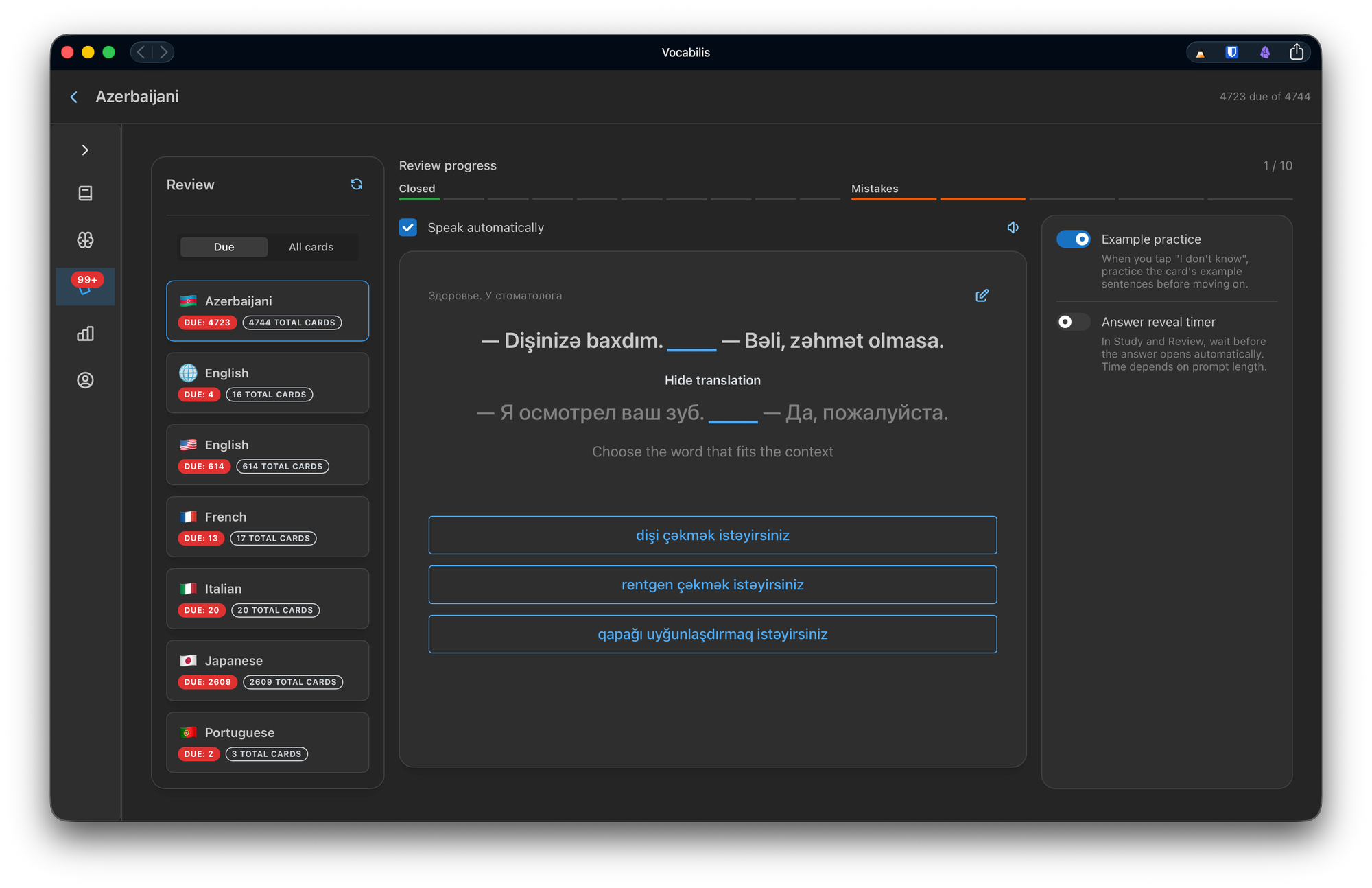
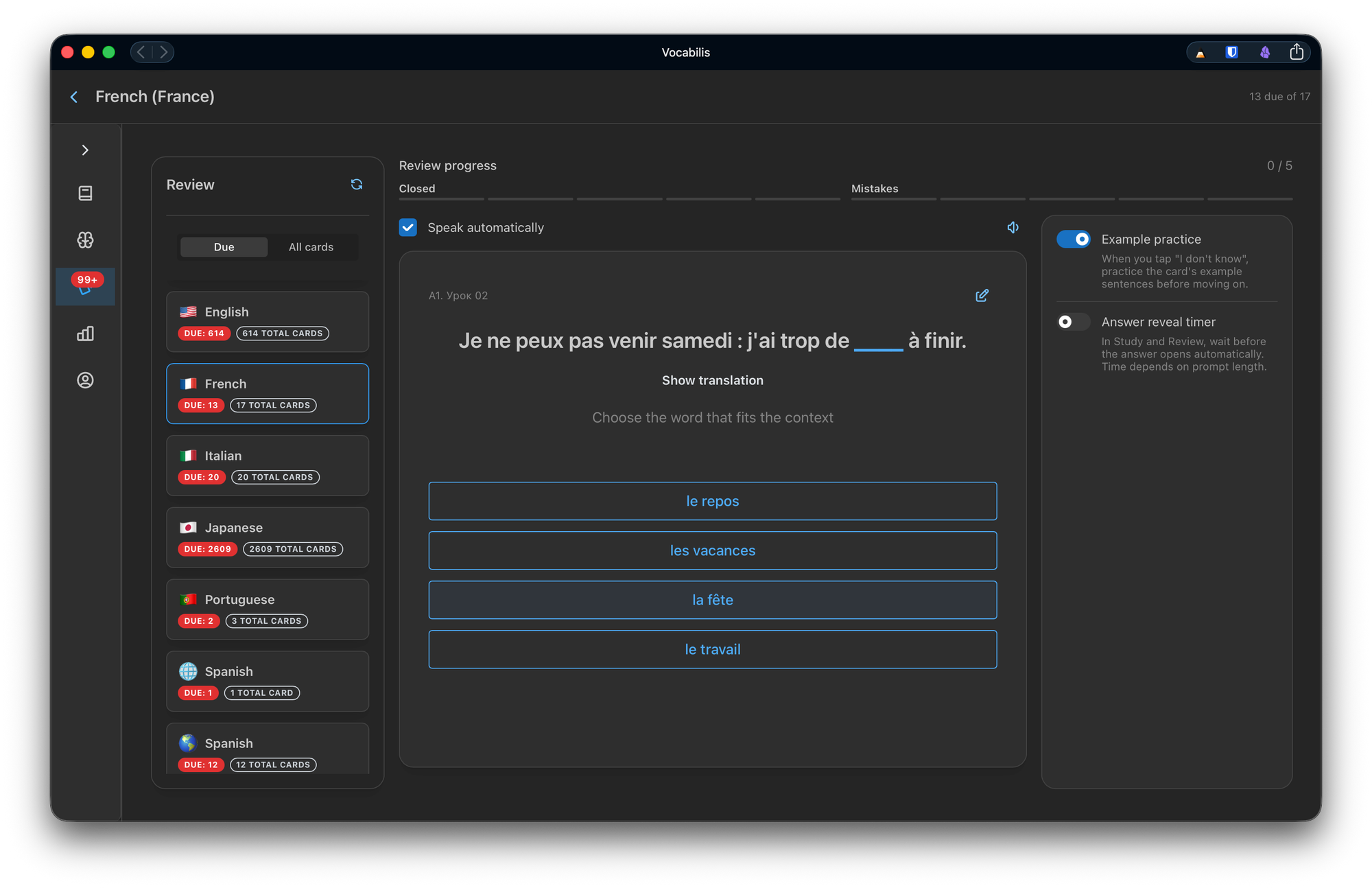
Instead of always showing a fixed card, the experiment generates a fresh L2 context around the target and turns that context into a small exercise, such as a cloze or multiple-choice question. The goal is not to make the learner memorize an endless stream of new sentences. The goal is to make the same lexical unit recognizable across changing contexts while keeping the review schedule familiar.
Dogfooding on a real backlog
We are testing the idea against a real Azerbaijani collection with about 4,700 overdue reviews. That makes the experiment useful in a very practical way: the system has to meet a large, imperfect review backlog rather than a carefully prepared demonstration set.
The early signal is encouraging for individual words and for many lexical units. Phrases have been more revealing. They exposed problems in the approach that we are still fixing, which is exactly the kind of feedback a real backlog is supposed to produce.
A translation can help — and still get in the way
The experiment also surfaced a different problem. When the Russian meaning is permanently visible, it can become the easiest thing to look at. That distracts from working out what the L2 context itself is saying.
So the direction here is not to remove translation. It is to change its role: translation should become optional, on-demand scaffolding that a learner can reveal when needed, rather than a permanently visible answer sitting beside every context.
What we are learning
Contextual SRS is still an experiment, but it is already clarifying the shape of the problem. Scheduling and generation are related, yet they do not need to be the same mechanism. A good review system can decide that a lexical unit is due without deciding that it must be presented in exactly the same form as before.
The next work is straightforward to describe, even if the details are not: improve how phrases are handled, keep testing fresh contextual exercises against real reviews, and make help available without letting that help replace the act of understanding.
That is the direction of Contextual SRS: less practice at recalling a card, and more practice at recognizing and using the lexical unit wherever it appears.
Обсуждение